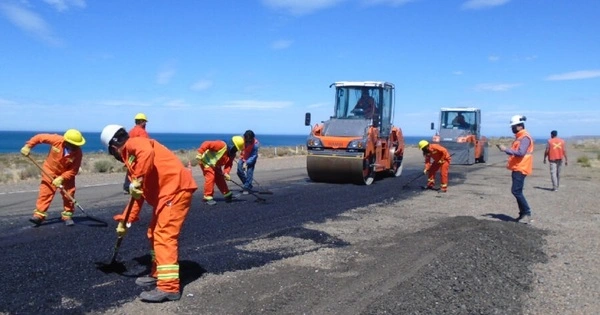
2025 marked a turning point in the recent history of Argentina's public infrastructure. As part of the fiscal consolidation program implemented by the national government, investment in infrastructure suffered an unprecedented contraction in real terms: according to data from the Ministry of Economy, spending on national public works fell 44% in constant pesos compared to 2024, representing just 0.7% of GDP — the lowest level since 2003. Road works, social housing, water infrastructure, and university facilities were among the categories with the steepest cuts in budget execution.
What was halted and what kept moving
The cutbacks were not uniform across sectors. Social housing projects under the PROCREAR program and the National Housing Fund (FONAVI) saw a 61% year-on-year drop in execution, leaving thousands of residential units stalled across different provinces. In road infrastructure, the National Directorate of Vialidad executed only 38% of its original budget, concentrating progress on strategic corridors linked to agro-industrial production and the Vaca Muerta formation. By contrast, energy infrastructure works — particularly gas pipelines and electricity transmission networks tied to unconventional hydrocarbon development — maintained above-average execution rates, reflecting the strategic priority assigned to the energy sector. To explore the geographic and sectoral breakdown of public investment, visit our interactive public works dashboard.
Impact on construction activity and employment
The freeze on public works had direct effects on the construction sector, one of Argentina's largest generators of both formal and informal employment. The Synthetic Construction Activity Indicator (ISAC) recorded an 18% cumulative decline in the first half of 2025 compared to the same period in 2024, though it showed a gradual recovery in the second half as private construction — driven by the capital amnesty program and UVA mortgage credit — partially offset the public contraction. According to the Labor Indicators Survey from the Ministry of Human Capital, registered construction employment fell 12% between January and June 2025 compared to the prior year. This dynamic can be explored in detail on our economic activity dashboard, where the construction sector is broken down on a month-by-month basis.
The outlook for 2026 points to a gradual but limited recovery in public infrastructure investment. The 2026 national budget includes a 35% nominal increase in public works spending — equivalent to a real increase of just 8% over the depressed 2025 baseline. The government's focus is on projects with external financing from the IDB, World Bank, and CAF, which allow strategic infrastructure to advance without compromising fiscal balance. The challenge is clear: rebuild public investment capacity without giving up the gains achieved in fiscal consolidation. For a broader look at how public spending evolved in 2025, read our article on the distribution of public spending in 2025.
Sources: Argentina's Ministry of Economy (Presupuesto Abierto), National Directorate of Vialidad, INDEC (ISAC), Ministry of Human Capital.